

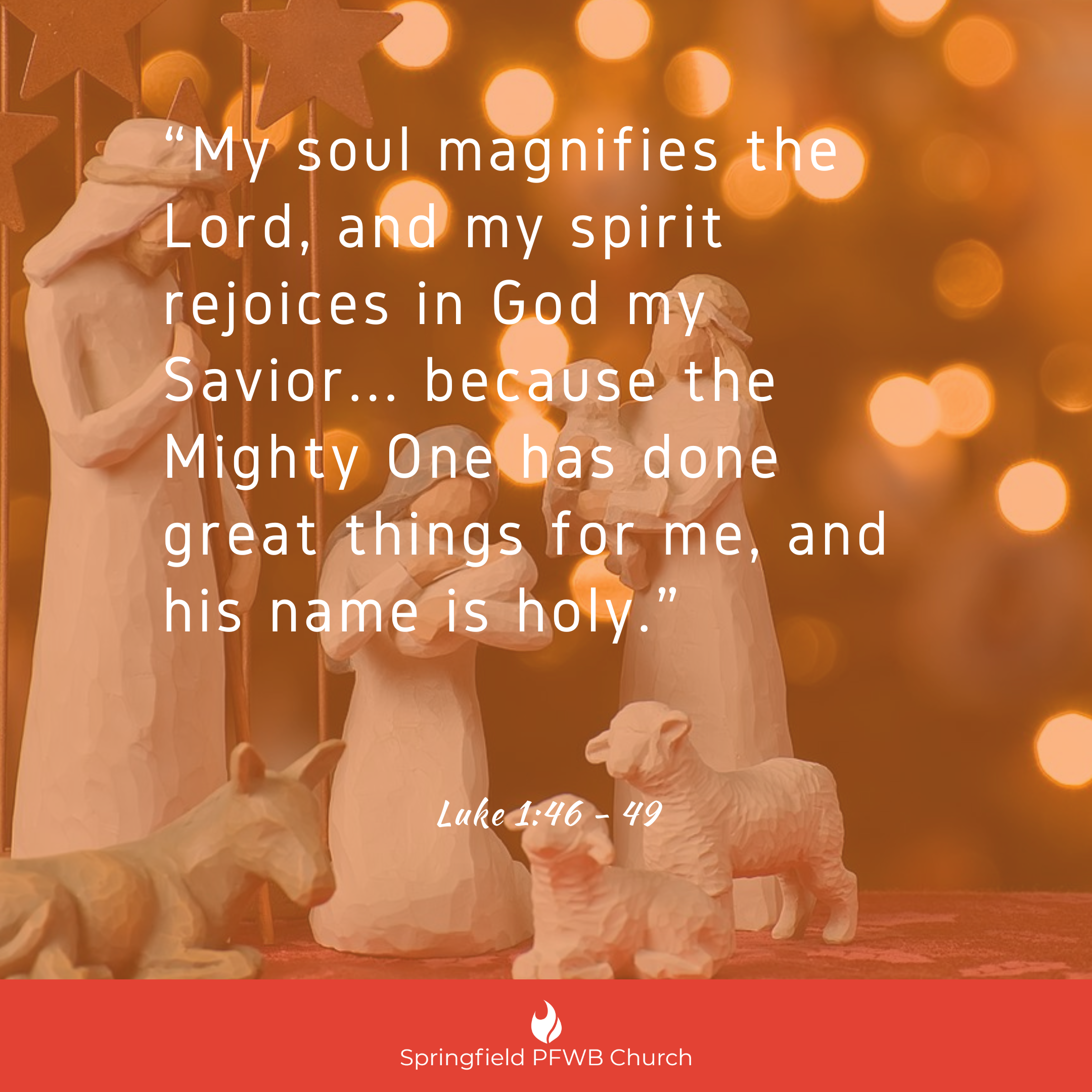
46 And Mary said:
My soul magnifies the Lord,
47 and my spirit rejoices in God my Savior,
48 because he has looked with favor
on the humble condition of his servant.
Surely, from now on all generations
will call me blessed,
49 because the Mighty One
has done great things for me,
and his name is holy. -- Luke 1:46-49 (CSB)

Advent Readings (Lk. 1:34-38)

34 Mary asked the angel, “How can this be, since I have not had sexual relations with a man? ”
35 The angel replied to her, “The Holy Spirit will come upon you, and the power of the Most High will overshadow you. Therefore, the holy one to be born will be called the Son of God. 36 And consider your relative Elizabeth — even she has conceived a son in her old age, and this is the sixth month for her who was called childless. 37 For nothing will be impossible with God.”
38 “See, I am the Lord’s servant,” said Mary. “May it happen to me as you have said.” Then the angel left her. -- Luke 1:34-38 (CSB)
TODAY: Hayride (Christmas Caroling)

Join us this afternoon for a Christmas caroling hayride.
The hay truck will depart from the church at 4 PM. Refreshments will be served in the Fellowship Hall afterward.
Questions? Contact us.
Advent Readings (Lk. 1:28-33)

28 And the angel came to her and said, “Greetings, favored woman! The Lord is with you.” 29 But she was deeply troubled by this statement, wondering what kind of greeting this could be. 30 Then the angel told her, “Do not be afraid, Mary, for you have found favor with God. 31 Now listen: You will conceive and give birth to a son, and you will name him Jesus. 32 He will be great and will be called the Son of the Most High, and the Lord God will give him the throne of his father David. 33 He will reign over the house of Jacob forever, and his kingdom will have no end.” -- Luke 1:28-33 (CSB)
Advent Readings (Is. 9:2-6)

2 The people walking in darkness
have seen a great light;
a light has dawned
on those living in the land of darkness.
3 You have enlarged the nation
and increased its joy.
The people have rejoiced before you
as they rejoice at harvest time
and as they rejoice when dividing spoils.
4 For you have shattered their oppressive yoke
and the rod on their shoulders,
the staff of their oppressor,
just as you did on the day of Midian.
5 For every trampling boot of battle
and the bloodied garments of war
will be burned as fuel for the fire.
6 For a child will be born for us,
a son will be given to us,
and the government will be on his shoulders.
He will be named
Wonderful Counselor, Mighty God,
Eternal Father, Prince of Peace. -- Isaiah 9:2-6 (CSB)
TONIGHT: Church Christmas Party

If you RSVP’d for this year’s Church Christmas Party, don’t forget to join us tonight in the Fellowship Hall. Supper is served at 7 PM.
Questions? Contact us.
Verse 5: Desire of Nations

The prophet Haggai speaks of the rebuilding of the temple after the remnant of Israel returned from the Babylonian captivity. Solomon’s temple had been destroyed by the invading armies of Babylon and this new temple paled in comparison to the splendor of the original. In the sight of Israel, they had failed to recover the way things were when, in their minds, things were better. Into this disappointment, God speaks through His prophet, “…I will shake all the nations so that the desires (treasures, precious things) of all the nations will come, and I will fill this house with glory…” (Haggai 2:7).
At Christmas, we celebrate the coming of the One who filled the earth with His glory. Isaiah 9:6 foretells of a child who would be born, a Son who would be given, and among many names for this Messiah would be Prince of Peace. Places filled with the glory of Jesus are places that know peace, no matter how simple or grand they appear. Indeed, people filled with the glory of Jesus are people who know peace, no matter their ethnicity, race, gender, wealth, or any other dividing characteristic. We read in Ephesians 2 that Jesus gives us peace with God (Ephesians 2:13, 16-18), and when we are at peace with God, we can be at peace with one another (Ephesians 2:14-15, 18-22).
It's easy to look around today and feel like the Israelite remnant of Haggai’s day: things aren’t as good as they should be. But such despair betrays a poor understanding of the Messiah we celebrate, who pronounced that the kingdom of God is at hand (here and now, Matthew 4:17). Maybe, today’s despair cues us into a lack of imagination for what is surely to come: a day when “a vast multitude from every nation, tribe, people, and language, which no one could number, stand[s] before the throne and before the Lamb [who is Jesus]” (Revelation 7:9). A day when the whole world—including all of the people in it—will be filled with heaven’s peace.
“Rejoice! Emmanuel shall come to thee, O Israel!”
Verse 4: Key of David

In Isaiah 22:15-25, the prophet foretells the replacement of Shebna, an unfaithful steward, with Eliakim, who “will be like a father to the inhabitants of Jerusalem and to the house of Judah” (Isaiah 22:21). Notice the authority entrusted to Eliakim for a season: “I will place the key of the house of David on his shoulder; what he opens, no one can close; what he closes, no one can open” (Isaiah 22:22). To the problem of abused authority and manipulative control, God announces something better to come.
Is there any lack of abused authority and manipulative control today? Unfaithful stewards abound in government offices, places of business, family homes, and even in the house of God, the Church. This is not a new problem. Jesus, the Messiah Isaiah foretold, had powerfully strong words for unfaithful stewards of the temple during His earthly ministry. In Matthew 23, Jesus speaks curse (“woe to you…”) over the scribes and Pharisees, the religious leaders who controlled access to the temple and to the rhythms of worship. Among a litany of woes we read, “Woe to you, scribes and Pharisees, hypocrites! You shut the door of the kingdom of heaven in people’s faces. For you don’t go in, and you don’t allow those entering to go in” (Matthew 23:13). There is truly nothing new under the sun (Ecclesiastes 1:9).
To the problem of abused authority and manipulative control, God still announces something better to come. We read in Revelation 3:7 that Jesus is, “…the Holy One, the true One, the One who has the key of David, who opens and no one will close, and who closes and no one opens…” The baby we celebrate in the manger is the Messiah who defeated sin and death at Calvary, and who will return again in glory. Until that day, Jesus holds the true keys of authority to open wide our heavenly home. To the faithful, Jesus still declares, “I know your works. Look, I have placed before you an open door that no one can close because you have but little power…” (Revelation 3:8). The days of abused authority and manipulative control are numbered by Jesus, the only true steward of heaven.
“Rejoice! Emmanuel shall come to thee, O Israel!”
Verse 3: Thou Dayspring from on High

In Luke 1:5-24, we read of the priest, Zechariah, who was struck mute when his demand for a sign as proof of Gabriel’s message betrayed his unbelief. The priest of God, serving in the holy place of God, greeted by an angel of God, nonetheless struggled to receive the word of God. For at least nine months, Zechariah could not speak. But when his mouth was opened, Zechariah was filled with the Holy Spirit & prophesied of the coming Messiah: a horn of salvation in the house of David (Luke 1:69) & the dayspring from on high (Luke 1:78, KJV).
This usage of dayspring is unfamiliar in our modern English. The Greek word is more often translated “the east,” referencing the position from which the sun rises daily. A dayspring references a rising of light, a dawning. The prophet Malachi, hundreds of years before Zechariah, wrote of a coming day when the evil would feel the heat of God’s wrath, but to those who feared His name, “the sun of righteousness will rise with healing in its wings…” (Malachi 4:2). The coming of Jesus was the dawning of a new era in redemptive history, a light by which all things are seen & all darkness is put to flight.
Spiritual illumination is a defining mark of believers made alive in Christ. As Paul wrote to the Corinthian believers, “For God who said, ‘Let light shine out of darkness,’ has shone in our hearts to give the light of the knowledge of God’s glory in the face of Jesus Christ” (2 Corinthians 4:6). How do we know hope in darkness? How do we combat gloom & shadows of evil? Through the knowledge of the Christ who has come—God with us—and His Word. “We also have the prophetic word strongly confirmed, & you will do well to pay attention to it, as to a lamp shining in a dark place, until the day dawns & the morning star rises in your hearts” (2 Peter 1:19). May it be, until He comes again.
“Rejoice! Emmanuel shall come to thee, O Israel!”
Verse 2: Rod of Jesse

In Isaiah 11:1-10, the prophet foretells the coming of a rod (KJV), branch, or shoot (ESV, CSB) from the stump or family tree of Jesse, King David’s father. This coming One will be full of the Spirit of the Lord, a righteous & impartial judge, a pursuer of justice who lifts up the oppressed, & liberator of exiles.
These needs of Israel in a physical sense are not much different than the needs of God’s people in a spiritual sense today. Whether we’ve ever experienced oppression in a physical sense, we have experienced spiritual oppression from the accuser of our souls—what the carol refers to as Satan’s tyranny. Whether we’ve ever stood condemned in an earthly courtroom, in a spiritual sense, we are guilty of sin & in need of acquittal only available through the vicarious, imputed righteousness of another. Whether we’ve ever been literally imprisoned, we have been captive to the demands of a law we would not keep apart from being indwelt by the Holy Spirit.
In Acts 13:23 & Romans 15:12, we find New Testament references to Jesus as that rod of Jesse, both able & willing to save us from Satan, hell, death, & sin. At Christmas, we celebrate that He has come. We who are made alive in Christ, celebrate that we have now been saved from the penalty & the power of sin. Until Jesus returns, we look forward to the day when He will save us from the very presence of sin, & we rejoice.
“Rejoice! Emmanuel shall come to thee, O Israel!”