

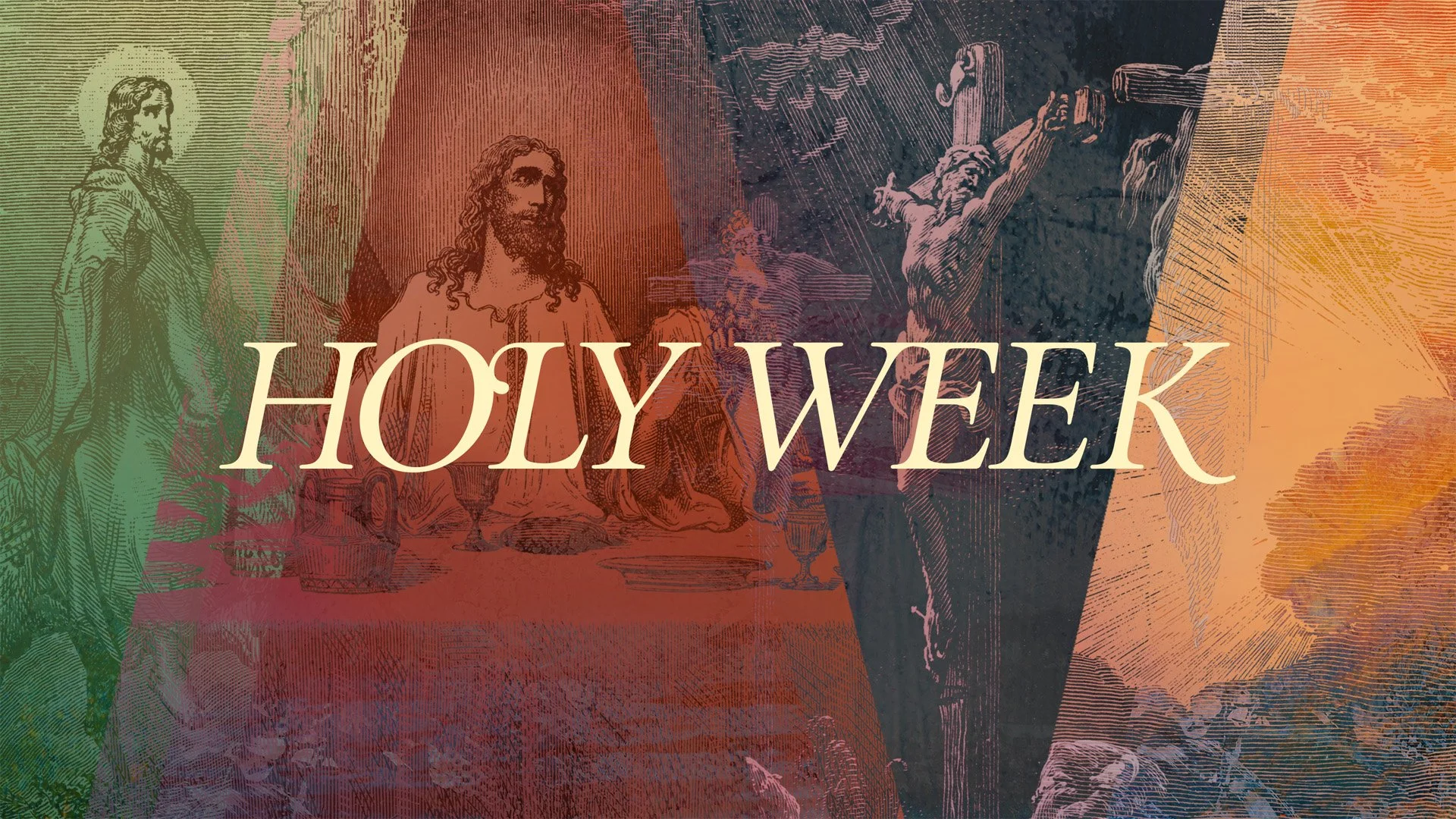
“Almighty God, whose most dear Son went not up to joy but first He suffered pain, and entered not into glory before He was crucified: Mercifully grant that we, walking in the way of the cross, may find it none other than the way of life and peace; through Jesus Christ Your Son our Lord, who lives and reigns with You and the Holy Spirit, one God, for ever and ever. Amen” (The 1979 Book of Common Prayer, 2005).

Holy Week: Palm Sunday

“…HAVING LOVED HIS OWN WHO WERE IN THE WORLD, [JESUS] LOVED THEM TO THE END” (JOHN 13:1).
Palm Sunday marks the beginning of the end of Jesus’ life on earth. Having loved His disciples throughout His ministry, Jesus continued toward Jerusalem and the cross that awaited. Heading wide-eyed toward a certain execution simply makes no sense unless we remember the truths we’ve already clung to during this Easter season. On Ash Wednesday we remembered that there is no resurrection that is not preceded by death. Throughout Lent we recalled that there is no exaltation that is not preceded by humility. On Palm Sunday we are reminded that the cross by necessity precedes the crown.
The events of the Sunday five days before Passover are recorded in all four gospels (Matthew 21:1-11; Mark 11:1-11; Luke 19:28-40; John 12:12-19). Three of the four accounts reference palm branches or leafy branches that the crowd waved and laid along the path into Jerusalem, along with their coats. Many liturgical churches today will hold processions into their sanctuaries waving palm branches commemorating the approach of Jesus into Jerusalem during the final week of His life on earth. But perhaps the most important symbol of the day is not the palm branches, but the unbroken (previously unridden) donkey colt, the symbol Jesus chose.

Around 520 BC, the prophet Zechariah foretold of the righteous and victorious King that will come to Jerusalem humbly, “riding… on a colt, the foal of a donkey” (Zech. 9:9). Approximately 550 years later, Jesus fulfills the sign of the King of the universe coming on a donkey’s colt.
Triumphal entries were by no means unique to the story of Jesus. The Roman Triumph (and here, and here) was as ingrained in the culture of the Roman Empire as fireworks on July 4, the celebration of Independence Day in the United States. Artistic depictions such as the Triumph of Aemilius Paulus by Carle Vernet (1789) illustrate the pomp and pageantry; victorious generals crowned with laurel wreaths riding into Rome in gilded chariots loaded down with the spoils of war, drawn by splendid horses. (More artistic examples are here, here, and here.)
Compared to such pageantry, how pitiful Jesus’ “triumphal” entry into Jerusalem must have seemed. Instead of laurel wreaths, the people simply hacked off palm branches to wave. Instead of a gilded chariot, people threw down their coats, both as a saddle and a path. Instead of mighty war horses, Jesus enters on a borrowed unbroken donkey foal—not even trained for riding. There are no spoils of war. And at the end of the path, there is not glory that awaits, but a cross, the highest dishonor Rome could offer.
Ignited by the resurrection of Lazarus of Bethany from the dead (John 11), the people saw in Jesus a hope of liberty and salvation. Yet, liberty and salvation from what? They tell us by the greeting they shouted at Jesus as He entered their midst:
Hosanna!
Blessed is He who comes
in the name of the Lord!Blessed is the coming kingdom
of our father David!
Hosanna in the highest heaven!Mark 11:9-10
“Hosanna!” The word is an urgent plea, an exhortation. “Save us now!” they cried. “Victory now!” they all but demanded. Having raised a man from death, could this Jesus not also subdue Rome? The people longed for the promise of a foretold king, but for what sort of kingdom—a heavenly or an earthly one? For what sort of liberty do they cry out—political or spiritual? This crowd yelled for a king to conquer Rome because they could not even see their greater need for the One King who would conquer sin and death. This blindness is precisely the reason Jesus wept for the city saying, “If you knew this day what would bring peace—but now it is hidden from your eyes” (Luke 19:41-42).
“Palm Sunday reveals Jesus’ humility. He is not like other kings who enter cities atop war horses in celebration of bloody victory. He is the humble king who saves by dying for the sins of the world” (McCauley, 2022). Jesus is certainly the promised Son of David, but the shape of that kingship is cruciform—cross-shaped. All of Jesus’ life, from His very first cries in the manger, have led to this moment, this place, this holy week.
As disciples (students and followers) of Christ, are we willing to follow on this road knowing it must pass through Golgotha, the place of death? Are we willing to trade the triumphant war horse for the humble donkey foal? “If we are going to follow Jesus, then we do not have to fight the way the world fights. We do not use their tools and means to get what we want” (McCauley, 2022). More than we do not, we cannot. Is the surpassing knowledge of Jesus Christ, the invitation of union with Him a dear enough prize that we would count all else as waste and declare with the apostle Paul, “My goal is to know Him and the power of His resurrection and the fellowship of His sufferings, being conformed to His death…” (Phil. 3:10, emphasis mine)? Will we join this prayer with the saints of the global church:
Almighty and everlasting God, in Your tender love for the human race You sent Your Son our Savior Jesus Christ to take upon Him our nature, and to suffer death upon the cross, giving us the example of His great humility: Mercifully grant that we may walk in the way of His suffering, and also share in His resurrection; through Jesus Christ our Lord, who lives and reigns with You and the Holy Spirit, one God, for ever and ever. Amen.
LEARN MORE ABOUT PALM SUNDAY AND THE REST OF THE EASTER SEASON
Lent: The Season of Repentance and Renewal (Fullness of Time) by Esau McCauley (2022, IVP Formatio)
The 1979 Book of Common Prayer (2005, Oxford University Press)
TOMORROW: Spring Revival Services Begin

Tomorrow!
Make plans to join us as we welcome Rev. Harvey Whaley, Jr. for Spring Revival Services, March 24 at 6 PM, and March 25-27 at 7:30 PM nightly. All are warmly welcome.
Read the Bible: Psalm 44

God, we have heard with our ears —
our ancestors have told us —
the work you accomplished in their days,
in days long ago:
2 In order to plant them,
you displaced the nations by your hand;
in order to settle them,
you brought disaster on the peoples.
3 For they did not take the land by their sword —
their arm did not bring them victory —
but by your right hand, your arm,
and the light of your face,
because you were favorable toward them.
4 You are my King, my God,
who ordains victories for Jacob.
5 Through you we drive back our foes;
through your name we trample our enemies.
6 For I do not trust in my bow,
and my sword does not bring me victory.
7 But you give us victory over our foes
and let those who hate us be disgraced.
8 We boast in God all day long;
we will praise your name forever. Selah
Psalms 44:1-8 (CSB)
Read the rest of Psalm 44, which speaks of Israel’s history and exile, using the link below.
Read the Bible: Psalm 43
Vindicate me, God, and champion my cause
against an unfaithful nation;
rescue me from the deceitful and unjust person.
2 For you are the God of my refuge.
Why have you rejected me?
Why must I go about in sorrow
because of the enemy’s oppression?
3 Send your light and your truth; let them lead me.
Let them bring me to your holy mountain,
to your dwelling place.
4 Then I will come to the altar of God,
to God, my greatest joy.
I will praise you with the lyre,
God, my God.
5 Why, my soul, are you so dejected?
Why are you in such turmoil?
Put your hope in God, for I will still praise him,
my Savior and my God.
Psalms 43:1-5 (CSB)
Read the Bible: Psalm 42

As a deer longs for flowing streams,
so I long for you, God.
2 I thirst for God, the living God.
When can I come and appear before God?
3 My tears have been my food day and night,
while all day long people say to me,
“Where is your God? ”
4 I remember this as I pour out my heart:
how I walked with many,
leading the festive procession to the house of God,
with joyful and thankful shouts.
5 Why, my soul, are you so dejected?
Why are you in such turmoil?
Put your hope in God, for I will still praise him,
my Savior and my God.
6 I am deeply depressed;
therefore I remember you from the land of Jordan
and the peaks of Hermon, from Mount Mizar.
7 Deep calls to deep in the roar of your waterfalls;
all your breakers and your billows have swept over me.
8 The Lord will send his faithful love by day;
his song will be with me in the night —
a prayer to the God of my life.
9 I will say to God, my rock,
“Why have you forgotten me?
Why must I go about in sorrow
because of the enemy’s oppression? ”
10 My adversaries taunt me,
as if crushing my bones,
while all day long they say to me,
“Where is your God? ”
11 Why, my soul, are you so dejected?
Why are you in such turmoil?
Put your hope in God, for I will still praise him,
my Savior and my God.
Psalms 42:1-11 (CSB)
TONIGHT: Ladies' Auxiliary & Brotherhood Meet

There is a place for you to serve among the women’s and men’s ministries at Springfield PFWB Church. Join us at 7 PM.
Sunday School is for All Ages!

Moses, with Aaron, returned to Egypt, confronted the Pharaoh, and did exactly what the Lord had commanded them to do. And for a time it made things much, much worse (Exodus 5:6-19). Even their Israelite kinsmen confronted them angrily (Exodus 5:20-21).
The illusion that perfectly obeying the will of God always leads to good things is rife among believers, but is not Biblical. Moses felt regret, but God was just getting started.
Sunday School for all ages begins weekly at 9:45 AM. All are warmly welcome.
Fifth Sunday of Lent (A Prayer)
“O Almighty God, you alone can bring into order the unruly wills and affections of sinners: Grant Your people grace to love what You command and desire what You promise; that, among the swift and varied changes of the world, our hearts may surely there be fixed where true joys are to be found; through Jesus Christ our Lord, who lives and reigns with You and the Holy Spirit, one God, for ever and ever. Amen” (The 1979 Book of Common Prayer, 2005).
Read more:
Read the Bible: Psalm 41

Happy is one who is considerate of the poor;
the LORD will save him in a day of adversity.
2 The LORD will keep him and preserve him;
he will be blessed in the land.
You will not give him over to the desire of his enemies.
3 The LORD will sustain him on his sickbed;
you will heal him on the bed where he lies.
4 I said, “LORD, be gracious to me;
heal me, for I have sinned against you.”
5 My enemies speak maliciously about me:
“When will he die and be forgotten? ”
6 When one of them comes to visit, he speaks deceitfully;
he stores up evil in his heart;
he goes out and talks.
7 All who hate me whisper together about me;
they plan to harm me.
8 “Something awful has overwhelmed him,
and he won’t rise again from where he lies! ”
9 Even my friend in whom I trusted,
one who ate my bread,
has raised his heel against me.
10 But you, LORD, be gracious to me and raise me up;
then I will repay them.
11 By this I know that you delight in me:
my enemy does not shout in triumph over me.
12 You supported me because of my integrity
and set me in your presence forever.
13 Blessed be the LORD God of Israel,
from everlasting to everlasting.
Amen and amen.
Psalms 41:1-13 (CSB)